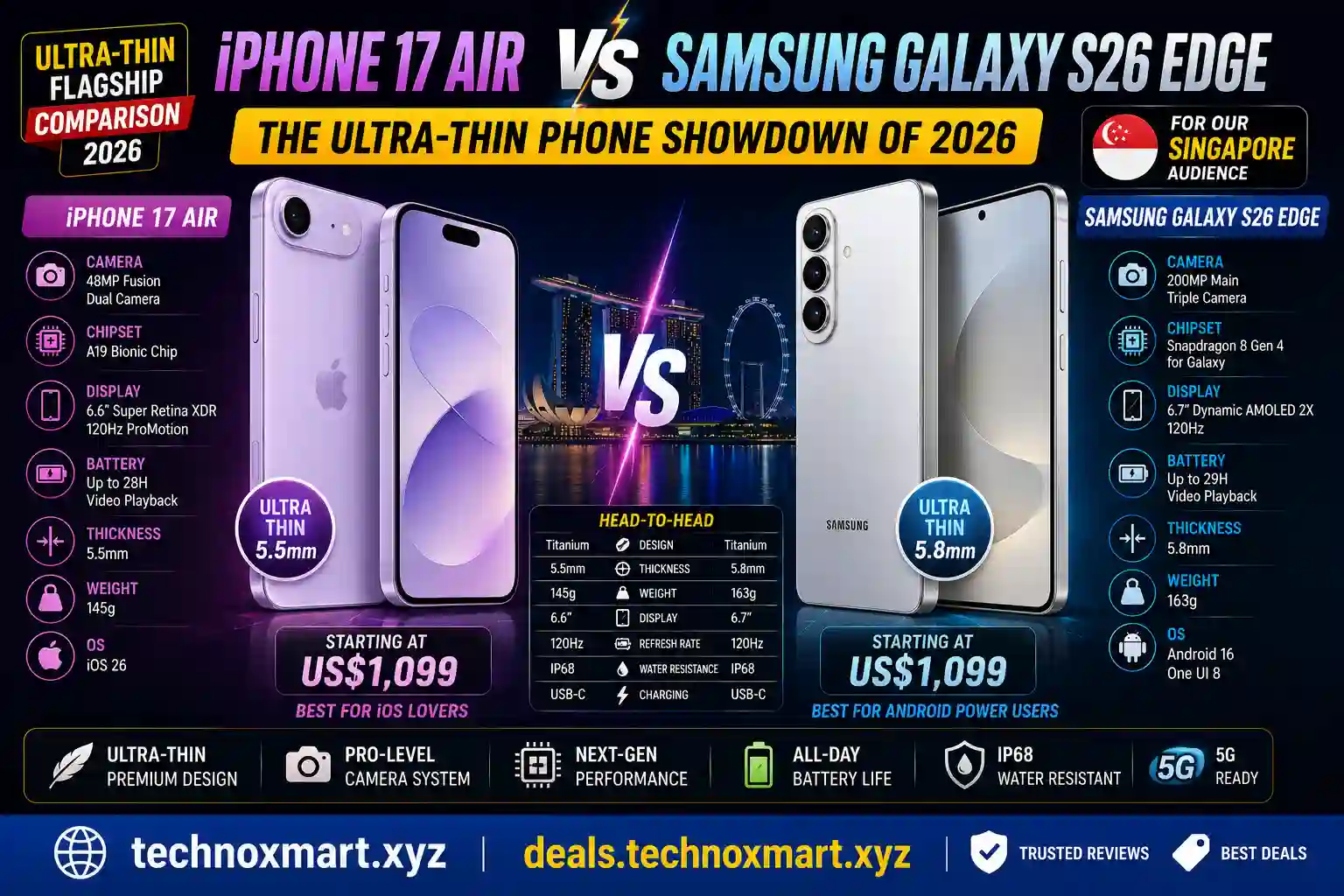
Ultra-thin smartphones are making a dramatic comeback, and 2026 is shaping up to be the year when sleek design matters just as much as raw performance. Instead of building heavier phones packed with oversized batteries, Apple and Samsung have taken a different approach—creating flagship devices that feel incredibly light in your hand while still delivering premium features. That has set up one of the year’s most interesting rivalries, with both brands targeting buyers who want style without sacrificing flagship performance.
If you’re deciding between Apple’s new iPhone 17 Air and Samsung’s Galaxy S26 Edge, you’re probably comparing two phones that sit in a very similar price bracket but offer noticeably different experiences. This iPhone 17 Air vs Samsung Galaxy S26 Edge comparison is designed specifically for readers in Singapore and the USA, covering the details that matter most—from pricing and cameras to AI features, battery life, and long-term value. By the end, you’ll know which ultra-thin flagship deserves your money in 2026.
Design & Build: Who Is Thinner?
The biggest talking point of these two phones is obvious the moment you pick them up.
The iPhone 17 Air is just 5.6mm thick and weighs approximately 165 grams, making it one of Apple’s thinnest smartphones ever. Apple uses a Grade 5 titanium frame, helping keep the device lightweight without compromising structural strength. Buyers can choose from Space Black, Cloud White, Light Gold, and Sky Blue, giving the Air a clean, premium appearance.
Samsung answers with the Galaxy S26 Edge, expected to measure around 6.2–6.4mm thick. While slightly thicker, it also features a titanium frame paired with a Gorilla Glass Victus 2 back for added durability. Samsung continues its tradition of offering more vibrant colour choices alongside its signature curved-edge display, making the phone feel futuristic in everyday use.
Both phones carry an IP68 water and dust resistance rating, so neither has an advantage when it comes to durability against rain or accidental splashes.
Apple clearly wins the raw thinness battle at 5.6mm versus roughly 6.2mm, while Samsung wins on display aesthetics and colour variety.
The compromise is unavoidable, though. Apple’s incredibly slim design limits it to a single rear camera, while Samsung’s ultra-thin body leaves less room for a large battery. That’s the price you pay for chasing the title of the thinnest smartphone 2026.
Display: Which Screen Wins?
Both phones deliver premium flagship displays, but they focus on different strengths.
The iPhone 17 Air features a 6.5-inch OLED display with ProMotion 120Hz refresh rate and up to 2,000 nits of peak brightness. Apple continues to lead in display calibration, producing exceptionally accurate colours that photographers and video creators appreciate when editing content directly on their phones.
Samsung counters with a larger 6.7-inch Dynamic AMOLED 2X display running at 120Hz. Its curved-edge design creates a more immersive appearance, while the display reaches an impressive 2,600 nits of peak brightness.
That extra brightness becomes surprisingly useful in Singapore. Whether you’re checking maps at Marina Bay Sands, browsing messages while walking around Sentosa, or using your phone outdoors during the afternoon, Samsung’s brighter screen remains easier to read under harsh sunlight.
Apple still has an important advantage. ProMotion dynamically adjusts the refresh rate more efficiently, helping reduce unnecessary battery drain while maintaining smooth scrolling. Combined with Apple’s industry-leading colour science, the display feels more natural when editing photos or reviewing videos.
If entertainment and outdoor visibility matter most, Samsung wins this round. If you’re a content creator who values colour accuracy, Apple’s display remains one of the best in the industry.
Camera: Single Lens vs Dual Camera
Looking purely at the hardware specifications, Samsung appears to have the obvious advantage.
The iPhone 17 Air features a single 48MP rear camera, relying heavily on the new A19 Pro chip to deliver computational photography that rivals phones with multiple sensors. Apple has spent years proving that software matters just as much as camera hardware, and the Air continues that philosophy.
The Samsung Galaxy S26 Edge offers a more versatile dual-camera system, combining a 50MP primary sensor with a 12MP ultrawide camera. That additional lens immediately gives Samsung more flexibility when capturing landscapes, city skylines, architecture, and large group photos.
Where Apple fights back is image processing. Thanks to the A19 Pro chip, the iPhone produces consistently excellent portrait photography with natural skin tones and impressive low-light performance when photographing a single subject. Faces look realistic rather than overly sharpened, making portraits feel more professional straight out of the camera.
You might also like ⬇️
☞ CMF Buds 2 Plus vs OnePlus Buds 4 vs Nothing Ear (a) 2: Which Should You Buy?
☞ Samsung Galaxy A57 vs Google Pixel 10a vs Nothing Phone 4a Pro: Best Mid-Range Phone in 2026?
☞ Google Pixel 10a vs Nothing Phone 4a Pro: Best $499 Phone in 2026?
☞ 📸 Best 10 Camera Phones in 2026 – Ultimate Smartphone Photography Guide
☞ 📱 Ultimate Smartphone Buying Guide 2026 – Camera, Gaming, Battery & More
Samsung still has the edge for travellers who enjoy wide scenic shots or frequently shoot in tight indoor spaces where an ultrawide lens becomes essential.
Selfie performance is also excellent on both devices. The iPhone uses an 18MP front camera, while Samsung includes a 12MP front camera that continues its strong reputation for video calls and social media content.
Our verdict is simple: if camera versatility is your top priority, the Galaxy S26 Edge is the better choice. If your focus is portrait photography, cinematic video, and Apple’s refined image processing, the iPhone Air vs Galaxy S26 Edge camera comparison becomes much closer than the hardware alone suggests.
Video Recording Comparison
Video creators have excellent options regardless of which phone they choose.
The iPhone 17 Air records 4K video at 60fps and supports Apple’s popular Cinematic mode, delivering smooth focus transitions that give videos a polished, professional look.
Samsung’s Galaxy S26 Edge also records 4K at 60fps, while adding Pro Video mode and Director’s View, making it easier to capture content from multiple perspectives and adjust manual recording settings.
For TikTok creators, InstagramReels, and YouTubeShorts, both phones perform exceptionally well.
If you’re producing professional content that requires colour grading and consistent footage across multiple projects, Apple’s video processing and editing workflow still maintain a slight advantage.
Performance & AI Features
Performance won’t be a concern on either flagship.
The iPhone 17 Air is powered by Apple’s A19 Pro chip, the same processor found in the iPhone 17 Pro series. Combined with an upgraded Neural Engine, it enables the latest Apple Intelligence features, including Writing Tools, Image Playground, Priority Notifications, and a smarter Siri with ChatGPT integration.
Samsung equips the Galaxy S26 Edge with the Snapdragon 8 Elite Gen 2 in the USA and Singapore, while some other regions may receive the Exynos 2600. Its Galaxy AI suite includes Circle to Search, Live Translate, Generative Edit, and Note Assist, offering practical AI tools that many users rely on every day.
Both manufacturers promise seven years of Android or iOS updates and security patches, making either device a safe long-term investment.
If you already own a Galaxy Watch or Galaxy Buds, Samsung’s ecosystem delivers the smoother experience. But if your daily devices include a MacBook, Apple Watch, AirPods, or iPad, the iPhone 17 Air integrates effortlessly and remains the more natural choice.
Battery Life: The Ultra-Thin Tax
The biggest compromise of owning an ultra-thin flagship isn’t the camera or durability—it’s battery capacity.
To achieve its incredibly slim 5.6mm profile, the iPhone 17 Air is expected to include a battery between 3,036mAh and 3,148mAh. That’s noticeably smaller than what you’d find in Apple’s Pro Max models, but it’s the trade-off required to create the thinnest iPhone ever.
The Samsung Galaxy S26 Edge is expected to feature a slightly larger battery of around 3,900mAh, giving it an advantage for users who spend long hours streaming videos, gaming, or navigating with GPS. While Samsung’s battery isn’t huge by flagship standards, the extra capacity makes a meaningful difference during everyday use.
In real-world conditions, the iPhone 17 Air should comfortably deliver around 18–20 hours of light usage or approximately 12 hours of heavy use. The Galaxy S26 Edge is likely to last a little longer, thanks to its larger battery and software optimizations.
Charging speed is another area where Samsung pulls ahead. Apple is expected to support 25W wired charging, while Samsung continues with 45W fast charging, allowing the Galaxy S26 Edge to recharge much faster when you’re in a hurry.
Here’s the honest truth: neither phone is designed for users who demand two full days of battery life. If your top priority is endurance, you’re better off choosing the iPhone 17 Pro Max or Galaxy S26 Ultra instead.
Hot Take: Most people overestimate how much battery they actually need. If your phone comfortably lasts 15–18 hours and supports fast charging, it’s usually enough for a normal day. The obsession with massive batteries often comes at the cost of comfort, weight, and design.
Price Comparison: USA & Singapore
Pricing plays a huge role in deciding between these two premium smartphones.
The iPhone 17 Air is expected to launch at $999 USD, while buyers in Singapore can expect a starting price of around SGD 1,299, making it one of Apple’s most affordable premium flagship models. If you’re searching for the iPhone 17 Air price Singapore, you’ll find it through the Apple Store Singapore, Shopee SG, Lazada SG, Challenger, and Harvey Norman shortly after launch.
The Samsung Galaxy S26 Edge USA price is expected to start at approximately $1,099 USD, with Singapore pricing around SGD 1,499. While Samsung’s launch price is roughly $100 higher than Apple’s in the United States, the company frequently offers aggressive carrier promotions, instant rebates, and generous trade-in bonuses that can reduce the effective purchase price to around $800–900 USD.
Singapore buyers have several purchasing options, including Samsung Experience Stores, Lazada, Shopee, SingTel, StarHub, and M1. Carrier bundles often include monthly installment plans, bonus accessories, or additional discounts.
For customers signing a new SingTel or StarHub contract, Samsung frequently provides stronger bundle deals than Apple. However, if you’re buying an unlocked phone outright without a carrier plan, the iPhone 17 Air delivers better value thanks to its lower starting price.
If you’re searching for the best slim phone under $1000 2026, Apple’s pricing gives it a noticeable advantage at launch.
Who Should Buy Which?
Not ready to spend $999 on an ultra-thin flagship? Google just launched the Pixel 11 at $899 with a brand-new 2nm chip and Pixel Glow notification ring — read our full breakdown: Google Pixel 11 vs Pixel 10a: Is the Upgrade Worth It in 2026?
Buy the iPhone 17 Air if you…
The iPhone 17 Air is built for buyers who value elegance, portability, and seamless integration with Apple’s ecosystem.
Choose it if you:
- Already own a MacBook, iPad, Apple Watch, or AirPods.
- Want the absolute thinnest and lightest iPhone Apple has ever released.
- Prefer realistic portrait photography and excellent skin-tone accuracy.
- Want access to Apple Intelligence, Writing Tools, Image Playground, and Siri with ChatGPT integration.
- Have a budget of $999 USD / SGD 1,299.
If you spend most of your day within Apple’s ecosystem, the Air feels like a natural extension of the devices you already own.
Buy the Samsung Galaxy S26 Edge if you…
Samsung’s flagship is ideal if versatility matters more than absolute thinness.
Choose it if you:
- Prefer a larger 6.7-inch curved-edge display.
- Want a dual-camera setup for ultrawide landscapes and group photos.
- Already use Galaxy Watch, Galaxy Buds, or other Samsung devices.
- Need 45W fast charging and slightly longer battery life.
- Have a budget of approximately $1,099 USD / SGD 1,499.
The Galaxy S26 Edge delivers a more flexible photography system while maintaining an ultra-premium design that stands out in the Android market.
You might also like ⬇️
☞ 📱 AI Smartphones vs Gaming Smartphones: Which One is Better in 2026?
☞ Nothing Phone (4a) Review: Bigger Battery, Telephoto Zoom & New Glyph Interface
☞ Xiaomi Pad 8 Global Launch: Price, Specifications, Snapdragon 8s Gen 4, and 11.2-Inch 3.2K Display
☞ Samsung Galaxy S26 Series Review: The AI Phone Narrative Begins
☞ iQOO 15R Review: 7600mAh Battery Beast with Snapdragon Power & 144Hz AMOLED Display
Best Buying Tips
If you’re shopping in Singapore, timing your purchase can save a surprising amount of money.
Major shopping events like 7.7, 8.8, 9.9, 10.10, and 11.11 on Shopee SG and Lazada SG often bring prices 5–10% below retail, especially when platform vouchers and bank promotions are combined.
For extra savings, activate cashback through ShopBack or Fave before checking out.
If you prefer trying the phones before buying, visit the Apple Store at ION Orchard or Jewel Changi Airport, or head to a Samsung Experience Store at Plaza Singapura or VivoCity.
Both phones are fully compatible with SingTel, StarHub, and M1 5G networks, ensuring excellent network performance across Singapore. Samsung also tends to offer stronger trade-in values through its official Singapore stores than Apple.
Final Verdict
The battle between the iPhone 17 Air vs Samsung Galaxy S26 Edge is much closer than it first appears.
Overall, the iPhone 17 Air takes the win because it delivers the thinnest design, flagship A19 Pro performance, Apple Intelligence, excellent portrait photography, and a lower starting price. It proves that you don’t need multiple cameras to create a premium smartphone experience.
For Singapore buyers, the Galaxy S26 Edge deserves serious consideration if you’re taking advantage of carrier bundles or trade-in promotions through SingTel, StarHub, or Samsung Experience Stores. Those deals can significantly reduce its real-world cost.
For USA buyers, the iPhone 17 Air offers stronger value at launch thanks to its $999 starting price, making it easier to recommend to most flagship shoppers.
If you’re looking for the best ultra-thin phone 2026, the iPhone 17 Air earns our recommendation by balancing design, performance, AI features, and price more effectively than its closest rival.
Which ultra-thin phone are you choosing in 2026? Drop your verdict in the comments below!
Frequently Asked Questions
1. Is iPhone 17 Air worth buying in 2026?
Yes, especially if you value portability, premium design, and Apple’s ecosystem. The A19 Pro chip, Apple Intelligence features, and lightweight titanium build make it an excellent choice for users who don’t need multiple rear cameras.
2. What is the difference between iPhone 17 Air and iPhone 17 Pro?
The iPhone 17 Air focuses on an ultra-thin design with a single 48MP rear camera and a lighter body, while the iPhone 17 Pro includes multiple cameras, a larger battery, and more advanced photography features for power users.
3. Is Samsung Galaxy S26 Edge available in Singapore?
Yes. The Galaxy S26 Edge is expected to be available through Samsung Experience Stores, SingTel, StarHub, M1, Shopee Singapore, Lazada Singapore, and other major retailers after its official launch.
4. Which is thinner — iPhone 17 Air or Samsung Galaxy S26 Edge?
The iPhone 17 Air is thinner at 5.6mm, while the Samsung Galaxy S26 Edge is expected to measure around 6.2–6.4mm. That makes Apple’s flagship the thinner device overall.
5. Does the iPhone 17 Air have good battery life?
The iPhone 17 Air delivers respectable battery life for such a slim device, offering approximately 18–20 hours of light use or around 12 hours of heavy use. However, users who prioritize maximum endurance should consider the iPhone 17 Pro Max instead.
𝑭𝒐𝒓 𝑹𝒆𝒈𝒖𝒍𝒂𝒓 & 𝑭𝒂𝒔𝒕𝒆𝒔𝒕 𝑻𝒆𝒄𝒉 𝑵𝒆𝒘𝒔 𝒂𝒏𝒅 𝑫𝒆𝒂𝒍𝒔&𝑶𝒇𝒇𝒆𝒓𝒔, 𝑭𝒐𝒍𝒍𝒐𝒘 𝑻𝑬𝑪𝑯𝑵𝑶𝑿𝑴𝑨𝑹𝑻 𝒐𝒏 𝑻𝒘𝒊𝒕𝒕𝒆𝒓, 𝑭𝒂𝒄𝒆𝒃𝒐𝒐𝒌, 𝑰𝒏𝒔𝒕𝒂𝒈𝒓𝒂𝒎, 𝑮𝒐𝒐𝒈𝒍𝒆 𝑵𝒆𝒘𝒔 𝒂𝒏𝒅 𝑺𝒖𝒃𝒔𝒄𝒓𝒊𝒃𝒆 𝑯𝒆𝒓𝒆 𝑵𝒐𝒘. 𝑩𝒚 𝑺𝒖𝒃𝒔𝒄𝒓𝒊𝒃𝒊𝒏𝒈 𝒀𝒐𝒖 𝑾𝒊𝒍𝒍 𝑮𝒆𝒕 𝑶𝒖𝒓 𝑫𝒂𝒊𝒍𝒚 𝑫𝒊𝒈𝒆𝒔𝒕 𝑯𝒆𝒂𝒅𝒍𝒊𝒏𝒆𝒔 𝑬𝒗𝒆𝒓𝒚 𝑴𝒐𝒓𝒏𝒊𝒏𝒈 𝑫𝒊𝒓𝒆𝒄𝒕𝒍𝒚 𝑰𝒏 𝒀𝒐𝒖𝒓 𝑬𝒎𝒂𝒊𝒍 𝑰𝒏𝒃𝒐𝒙. 𝗝𝗼𝗶𝗻 𝗢𝘂𝗿 𝗪𝗵𝗮𝘁𝘀𝗔𝗽𝗽 𝗖𝗵𝗮𝗻𝗻𝗻𝗲𝗹𝘀 𝗙𝗼𝗿 𝗡𝗲𝘄𝘀 & 𝗥𝗲𝗮𝗹 𝗧𝗶𝗺𝗲 𝗗𝗲𝗮𝗹 𝗔𝗹𝗲𝗿𝘁𝘀.