

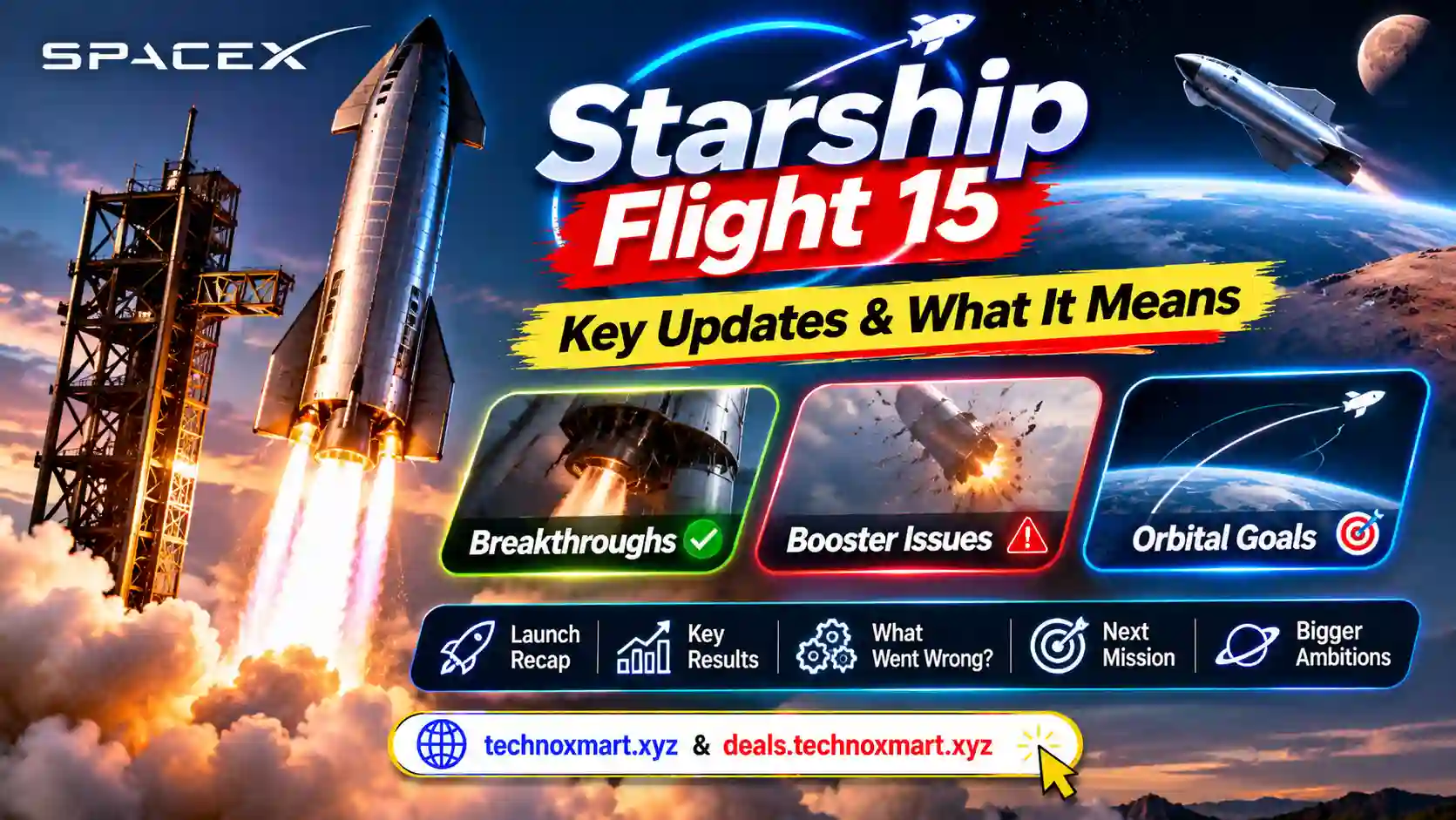
SpaceX has once again captured the world’s attention with its latest high-stakes orbital test flight. Starship Flight 15 lifted off from Starbase in South Texas, carrying a heavy payload of next-generation communication satellites and attempting an unprecedented double-catch maneuver using the iconic “Mechazilla” launch tower arms.
While the mission achieved major milestones, including successful orbit insertion and satellite deployment, it also ran into technical turbulence when an automated abort diverted the Super Heavy booster away from its tower-catch recovery.
Mission Overview: What Happened During Starship Flight 15?
Liftoff took place from Orbital Launch Pad 2 at Starbase, putting the upgraded Block 3 vehicle combination—Booster 22 and Ship 42—through its toughest test profile yet.
The primary objectives of the mission included:
- Full-System Recovery Test: An ambitious attempt to catch both the Super Heavy first stage and the Starship upper stage using the launch tower mechanical “chopsticks”.
- Starlink V3 Deployment: Delivering 26 next-generation Starlink V3 satellites into low Earth orbit to expand high-speed global connectivity.
- Long-Duration Orbital Coast: Putting Ship 42 through an extended multi-orbit coast phase spanning over 21 hours before a controlled reentry and terminal landing sequence.
Super Heavy Booster Malfunction and Offshore Divert
The centerpiece of SpaceX’s reusable rocket philosophy is the rapid recovery of booster stages directly at the launch site. However, during the descent phase of Flight 15, the Super Heavy booster suffered an unexpected malfunction.
- The Automatic Abort: Triggered automatically by onboard flight computers, the vehicle aborted its planned trajectory back toward the launch tower.
- Gulf of Mexico Splashdown: Instead of being clamped by the tower arms, Booster 22 was safely diverted toward an offshore splashdown zone in the Gulf of Mexico.
- Data Gathering: Even though the tower catch was called off, engineers gathered critical flight telemetry data on the behavior of the upgraded V3 propulsion and guidance systems during extreme atmospheric stress.
Starship Upper Stage Reaches Orbit and Prepares for Reentry
While the booster recovery sequence was altered, the upper-stage Ship 42 successfully pushed through stage separation and powered into orbit.
Deploying 26 massive Starlink V3 satellites, the upper stage added significant data capacity to the constellation. Furthermore, special monitoring satellites equipped with external cameras were utilized to inspect Ship 42’s thermal protection tiles in real time, validating its structural integrity for future crewed missions to the Moon and Mars.
Deep Dive: Starship Flight 15 Technical Architecture and Future Milestones
The execution of Starship Flight 15 marks an undeniable turning point for SpaceX’s heavy-lift roadmap. By transitioning away from short suborbital hops and moving directly into multi-orbit long-duration profiles, SpaceX is stress-testing the architecture required for interplanetary transit. This extended analytical addition delves into the structural upgrades of Block 3 hardware, the engineering rationale behind the Starlink V3 payload, and what the booster divert means for upcoming flights.
Inside the Block 3 Hardware Upgrades
Flight 15 utilized the fourth pairing of Block 3 vehicles—specifically Booster 22 and Ship 42. These iterations feature distinct aerodynamic and thermal improvements compared to their predecessors:
- Curved Thermal Protection Tiles: A major thermal vulnerability in earlier flights was plasma heating within the straight gaps between hexagonal tiles. Flight 15 tested a revised curved-edge tile profile designed to disrupt boundary-layer thermal pooling.
- Raptor Engine Refinements: The 33 Raptor engines on Booster 22 featured upgraded combustion chamber cooling channels and faster throttle response times, which are crucial for executing precise boostback and landing burns.
- Optimized Hot-Stage Ring: The structural ring responsible for staging survived the high-stress separation event cleanly, proving the reliability of the hot-staging configuration during heavy-payload missions.
The Strategic Importance of Starlink V3 Payloads
The inclusion of 26 next-generation Starlink V3 satellites on Ship 42 represents a massive leap in orbital networking capacity.
“V3 units are significantly more powerful than previous iterations, contributing roughly a terabit of additional data capacity to the constellation—equivalent to the deployment volume of roughly 10 standard Falcon 9 missions.”
Furthermore, three of the deployed V3 satellites carried specialized external monitoring cameras. These cameras lingered near Ship 42 after payload separation, providing engineers on the ground with high-definition optical data regarding tile integrity and structural wear following the violent shocks of Max-Q and orbital insertion.
Flight Profiles and the Multi-Orbit Validation Strategy
Unlike previous tests that wrapped up within an hour or two, Flight 15 was designed for a grueling 22-hour, 33-minute mission profile, pushing Ship 42 through roughly 14 complete orbits at an altitude of approximately 275 kilometers.
This extended duration tests critical long-term systems that traditional rockets never have to worry about during quick trips:
- Solar Array Degradation and Articulation: Ensuring power generation remains stable across multiple orbital day-night cycles.
- Propellant Boil-Off Management: Monitoring cryogenic header tank management and auto-pressurization systems during prolonged exposure to unfiltered solar radiation.
- Avionics Thermal Stability: Checking whether onboard computers and guidance sensors can handle extreme temperature shifts without system reboots or telemetry dropouts.
What the Booster Abort Means for Future Catch Attempts
While aerospace enthusiasts worldwide hoped to witness the historic “double-catch”—where both the Super Heavy booster and the upper-stage Starship are snatched by the Mechazilla tower arms—the automatic abort of Booster 22 highlights SpaceX’s conservative safety margins.
The flight control software is programmed to prioritize pad safety above all else. If trajectory parameters, wind shears, or hydraulic actuator feedback deviate by even a fraction of acceptable tolerances, the vehicle automatically redirects to an unpopulated ocean vector. Diverting Booster 22 to a controlled splashdown in the Gulf of Mexico ensured zero risk to the orbital launch mount while still allowing recovery teams to study telemetry and refine control algorithms for Flight 16.
Frequently Asked Questions (FAQ)
1. Did SpaceX launch Starship today?
Yes, SpaceX successfully launched Starship Flight 15 from Starbase in South Texas, achieving upper-stage orbit insertion and deploying its satellite payload.
2. Why was the Super Heavy booster catch cancelled?
The Super Heavy booster experienced an automatic system abort during its return sequence, prompting flight controllers to divert the rocket safely into an offshore splashdown in the Gulf of Mexico rather than attempting a tower catch.
3. What payload was carried on Starship Flight 15?
The flight carried 26 next-generation Starlink V3 broadband satellites designed to substantially upgrade orbital network capacity.
4. How long does Starship Flight 15 stay in orbit?
The mission plan dictates a total duration of approximately 22 hours and 33 minutes across roughly 14 orbits before a final targeted reentry and landing sequence.
5. What are Starlink V3 satellites, and why do they matter?
Starlink V3 satellites are larger, highly powered broadband units capable of delivering immense bandwidth upgrades to low Earth orbit, drastically lowering global latency and expanding network capacity.
6. Will SpaceX attempt another tower catch on future flights?
Yes. Despite the automated abort on Booster 22 during this flight, SpaceX remains fully committed to achieving a full-stack dual catch, using data gathered from Flight 15 to fine-tune future hardware iterations.
For Regular & Fastest Tech News and Deals&Offers, Follow TECHNOXMART on Twitter, Facebook, Instagram, Google News and Subscribe Here Now. Join our WhatsApp Channels For News & Real Time Deal Alerts.