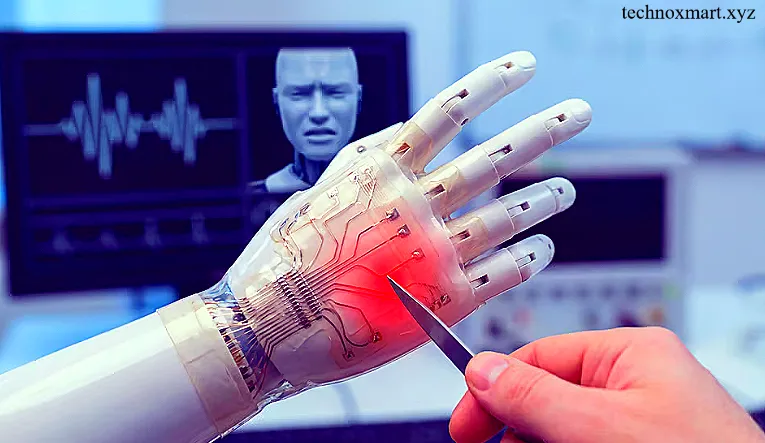
The NRE-skin has an integrated pain center that protects the robot from harm and responds almost immediately to harmful stimuli.
Under the direction of Yuyu Gao, a team of researchers at the City University of Hong Kong has created a neuromorphic robotic “e-skin” that replicates the human nervous system. In order to differentiate between painful force and soft touch, the multilayer artificial skin transforms pressure into neural-like pulses. It opens the door to more “empathetic” robots that can safely interact with people by enabling humanoid robots to sense touch, identify harm, and initiate defensive reflexes, much like a human reaction arc.
Reflexes and Active Pain Detection
The four-layer structure of the skin resembles human nerves, accordingto the study that was published as part of a PNAS report. Spike signals are sent to the central processor for interpretation when they come into light contact. However, the skin initiates an instantaneous response by delivering a high-voltage pulse straight to the motors, avoiding the CPU and prompting the robotto retreat if pressure over a certain pain threshold.
You will also like these ▼
☞ NASA Finds Starquakes in a Red Giant Circling One of the Quietest Black Holes in the Galaxy
☞ Battery Innovation Increases Stability and Charging Efficiency with New Carbon Material
☞ The Arctic Report Card identifies new risks, record heat, and rapid warming.
☞ ISS astronauts send messages to Earth and celebrate Christmas in orbit.
☞ OpenAI and Anthropic Offer Certain Users a Double Usage Limit Through the New Year
☞ Quantum Haloscope Sharpens the Search for Dark Matter Axions at Higher Frequencies
In actuality, the NRE-skin has an integrated pain center that responds to hazardous stimuli very instantaneously and shields the robot from harm.
Self-Repair and Modular Design
One interesting characteristic of the NRE-skin is its ability to monitor its own health. Every sensor emits a standard “still here” signal; if a patch is severed, the signal ceases, alerting the system to the damaged component. The skin utilizes magnetic modules since it is incapable of healing itself.
When a patch is broken, it can be replaced in a matter of seconds and pops off like a Lego piece. Additionally, the team wants to increase its sensitivity so that robots can detect several touches simultaneously.
𝑭𝒐𝒓 𝑹𝒆𝒈𝒖𝒍𝒂𝒓 & 𝑭𝒂𝒔𝒕𝒆𝒔𝒕 𝑻𝒆𝒄𝒉 𝑵𝒆𝒘𝒔 𝒂𝒏𝒅 𝑫𝒆𝒂𝒍𝒔&𝑶𝒇𝒇𝒆𝒓𝒔, 𝑭𝒐𝒍𝒍𝒐𝒘 𝑻𝑬𝑪𝑯𝑵𝑶𝑿𝑴𝑨𝑹𝑻 𝒐𝒏 𝑻𝒘𝒊𝒕𝒕𝒆𝒓, 𝑭𝒂𝒄𝒆𝒃𝒐𝒐𝒌, 𝑰𝒏𝒔𝒕𝒂𝒈𝒓𝒂𝒎, 𝑮𝒐𝒐𝒈𝒍𝒆 𝑵𝒆𝒘𝒔 𝒂𝒏𝒅 𝑺𝒖𝒃𝒔𝒄𝒓𝒊𝒃𝒆 𝑯𝒆𝒓𝒆 𝑵𝒐𝒘. 𝑩𝒚 𝑺𝒖𝒃𝒔𝒄𝒓𝒊𝒃𝒊𝒏𝒈 𝒀𝒐𝒖 𝑾𝒊𝒍𝒍 𝑮𝒆𝒕 𝑶𝒖𝒓 𝑫𝒂𝒊𝒍𝒚 𝑫𝒊𝒈𝒆𝒔𝒕 𝑯𝒆𝒂𝒅𝒍𝒊𝒏𝒆𝒔 𝑬𝒗𝒆𝒓𝒚 𝑴𝒐𝒓𝒏𝒊𝒏𝒈 𝑫𝒊𝒓𝒆𝒄𝒕𝒍𝒚 𝑰𝒏 𝒀𝒐𝒖𝒓 𝑬𝒎𝒂𝒊𝒍 𝑰𝒏𝒃𝒐𝒙. 𝗝𝗼𝗶𝗻 𝗢𝘂𝗿 𝗪𝗵𝗮𝘁𝘀𝗔𝗽𝗽 𝗖𝗵𝗮𝗻𝗻𝗻𝗲𝗹𝘀 𝗙𝗼𝗿 𝗡𝗲𝘄𝘀 & 𝗥𝗲𝗮𝗹 𝗧𝗶𝗺𝗲 𝗗𝗲𝗮𝗹 𝗔𝗹𝗲𝗿𝘁𝘀.