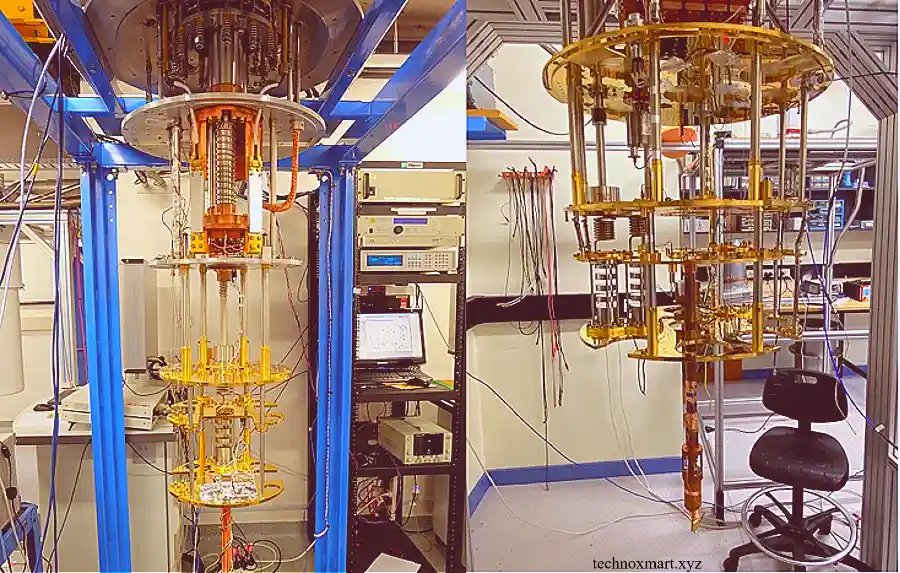
The search for dark matter remains one of the most important challenges in modern physics. Despite making up nearly 85 percent of all matter in the universe, dark matter has never been directly observed. Scientists can infer its presence only through its gravitational effects on galaxies and cosmic structures. Among the many proposed candidates, axions have emerged as one of the most promising explanations. Now, a new quantum haloscope experiment has pushed the search for axion dark matter into higher-frequency—and higher-mass—regions than ever before.
Researchers from Italy’s QUAX (QUaerere AXion) collaboration have announced fresh results from an advanced experiment designed to detect axions using quantum-limited technology. While the study did not confirm a direct axion signal, it represents a major technical breakthrough in dark matter research and significantly strengthens future detection efforts.
Why Axions Are Leading Dark Matter Candidates
Axions were originally proposed in the late 1970s to solve a theoretical issue in particle physics known as the strong CP problem. Over time, scientists realized that these hypothetical particles could also explain the missing mass of the universe. Axions are believed to be extremely light, electrically neutral, and capable of interacting only weakly with ordinary matter—properties that align well with what physicists expect from dark matter.
Because axions interact so faintly with known particles, detecting them directly is extraordinarily difficult. However, if axions exist, they should be present throughout the Milky Way as part of the galactic dark matter halo, passing through Earth constantly. Detecting even a tiny signal would provide revolutionary insight into the nature of the universe.
Quantum Haloscope: Turning Axions into Detectable Light
One of the most effective techniques for axion detection is the haloscope, a device first proposed by physicist Pierre Sikivie. A haloscope exploits the theoretical prediction that axions can convert into photons when exposed to a strong magnetic field.
The QUAX experiment uses a highly sensitive microwave cavity placed inside an intense magnetic field. If axions with the correct mass enter the cavity, they may convert into microwave photons with a frequency directly related to the axion’s mass. This signal would appear as an extremely faint excess of electromagnetic radiation—far weaker than everyday background noise.
To detect such tiny signals, the QUAX team employed quantum-limited amplifiers, which operate close to the fundamental limits imposed by quantum mechanics. These amplifiers are essential for distinguishing potential axion signals from thermal and electronic noise.
High-Frequency Axion Search Breaks New Ground
According to a reportby Phys.org, the results of the study were published in Physical Review Letters, one of the most prestigious journals in physics. The experiment focused on axion masses above 40 microelectronvolts, pushing into a high-frequency axion search regime that has remained largely unexplored until now.
This mass range is particularly important because recent theoretical models suggest that heavier axions could still account for the total dark matter abundance of the universe. However, searching at higher frequencies presents significant engineering challenges. Higher axion masses correspond to higher photon frequencies, requiring smaller and more precisely controlled microwave cavities.
The QUAX collaboration addressed this challenge by developing a tunable cavity system, allowing the experiment to scan across multiple frequencies without rebuilding the apparatus. This innovation enables efficient coverage of a wider range of possible axion masses using a single setup.
You will also like these ▼
☞ NASA Finds Starquakes in a Red Giant Circling One of the Quietest Black Holes in the Galaxy
☞ Battery Innovation Increases Stability and Charging Efficiency with New Carbon Material
☞ The Arctic Report Card identifies new risks, record heat, and rapid warming.
☞ ISS astronauts send messages to Earth and celebrate Christmas in orbit.
☞ OpenAI and Anthropic Offer Certain Users a Double Usage Limit Through the New Year
New Constraints on Axion Dark Matter Models
.webp "Quantum Haloscope Sharpens the Search for Dark Matter Axions at Higher Frequencies 2")
Although the experiment did not observe a clear axion signal, the absence of detection is scientifically valuable. By ruling out axions within certain mass and coupling ranges, the QUAX haloscope places new limits on axion dark matter models. These constraints help refine theoretical predictions and guide future experiments toward more promising parameter spaces.
Equally important, the study demonstrated long-term operational stability, precise frequency control, and reliable quantum-level sensitivity. These achievements confirm that quantum haloscope technology is viable for sustained dark matter searches.
What Comes Next in Axion Dark Matter Research
The QUAX team plans to further improve the experiment’s sensitivity by enhancing magnetic field strength, reducing environmental noise, and upgrading quantum amplifier performance. Future versions of the haloscope may also explore an even broader frequency range and incorporate greater automation for continuous scanning.
A confirmed detection of axions would represent the first direct observation of dark matter, transforming both cosmology and particle physics. It would validate decades of theoretical work and open the door to entirely new technologies based on axion properties.
For now, experiments like QUAX show how quantum technologies are revolutionizing the hunt for dark matter. Each improvement narrows the search and brings scientists closer to solving one of the universe’s greatest mysteries: the true nature of the invisible matter that holds galaxies together.
Beyond the immediate implications for axion dark matter, the success of the QUAX experiment highlights the growing role of quantum sensing technologies in fundamental physics. Techniques such as quantum-limited amplification, ultra-low-noise measurement, and precision frequency control are now enabling experiments to probe physical phenomena once thought unreachable. These tools are not only essential for axion detection but are also influencing other areas of research, including gravitational wave detection, precision metrology, and searches for new fundamental forces.
The global scientific community is increasingly coordinating efforts to explore complementary regions of axion parameter space. While experiments such as ADMX focus on lower-mass axions, high-frequency quantum haloscopes like QUAX are filling critical gaps by targeting heavier axion candidates. This diversified strategy ensures that a wide range of theoretical models for dark matter axions are tested, accelerating progress toward a definitive answer. International collaboration and shared technological advances are proving essential in tackling a problem of this scale.
Ultimately, the continued refinement of quantum haloscope experiments underscores the long-term nature of dark matter research. Discoveries at the frontier of physics often require years of incremental improvements, patient experimentation, and repeated null results. Each study, including this latest QUAX search, sharpens our understanding of what dark matter is—and what it is not. As sensitivity improves and unexplored frequency ranges come within reach, the possibility of directly detecting axions moves from theoretical hope to experimental reality.
𝑭𝒐𝒓 𝑹𝒆𝒈𝒖𝒍𝒂𝒓 & 𝑭𝒂𝒔𝒕𝒆𝒔𝒕 𝑻𝒆𝒄𝒉 𝑵𝒆𝒘𝒔 𝒂𝒏𝒅 𝑫𝒆𝒂𝒍𝒔&𝑶𝒇𝒇𝒆𝒓𝒔, 𝑭𝒐𝒍𝒍𝒐𝒘 𝑻𝑬𝑪𝑯𝑵𝑶𝑿𝑴𝑨𝑹𝑻 𝒐𝒏 𝑻𝒘𝒊𝒕𝒕𝒆𝒓, 𝑭𝒂𝒄𝒆𝒃𝒐𝒐𝒌, 𝑰𝒏𝒔𝒕𝒂𝒈𝒓𝒂𝒎, 𝑮𝒐𝒐𝒈𝒍𝒆 𝑵𝒆𝒘𝒔 𝒂𝒏𝒅 𝑺𝒖𝒃𝒔𝒄𝒓𝒊𝒃𝒆 𝑯𝒆𝒓𝒆 𝑵𝒐𝒘. 𝑩𝒚 𝑺𝒖𝒃𝒔𝒄𝒓𝒊𝒃𝒊𝒏𝒈 𝒀𝒐𝒖 𝑾𝒊𝒍𝒍 𝑮𝒆𝒕 𝑶𝒖𝒓 𝑫𝒂𝒊𝒍𝒚 𝑫𝒊𝒈𝒆𝒔𝒕 𝑯𝒆𝒂𝒅𝒍𝒊𝒏𝒆𝒔 𝑬𝒗𝒆𝒓𝒚 𝑴𝒐𝒓𝒏𝒊𝒏𝒈 𝑫𝒊𝒓𝒆𝒄𝒕𝒍𝒚 𝑰𝒏 𝒀𝒐𝒖𝒓 𝑬𝒎𝒂𝒊𝒍 𝑰𝒏𝒃𝒐𝒙. 𝗝𝗼𝗶𝗻 𝗢𝘂𝗿 𝗪𝗵𝗮𝘁𝘀𝗔𝗽𝗽 𝗖𝗵𝗮𝗻𝗻𝗻𝗲𝗹𝘀 𝗙𝗼𝗿 𝗡𝗲𝘄𝘀 & 𝗥𝗲𝗮𝗹 𝗧𝗶𝗺𝗲 𝗗𝗲𝗮𝗹 𝗔𝗹𝗲𝗿𝘁𝘀.